21805 FOOTHILL BLVD, HAYWARD, CA 94541
 1-510-581-6804
Who Repairs Aluminum Oil Coolers Near Berkeley?
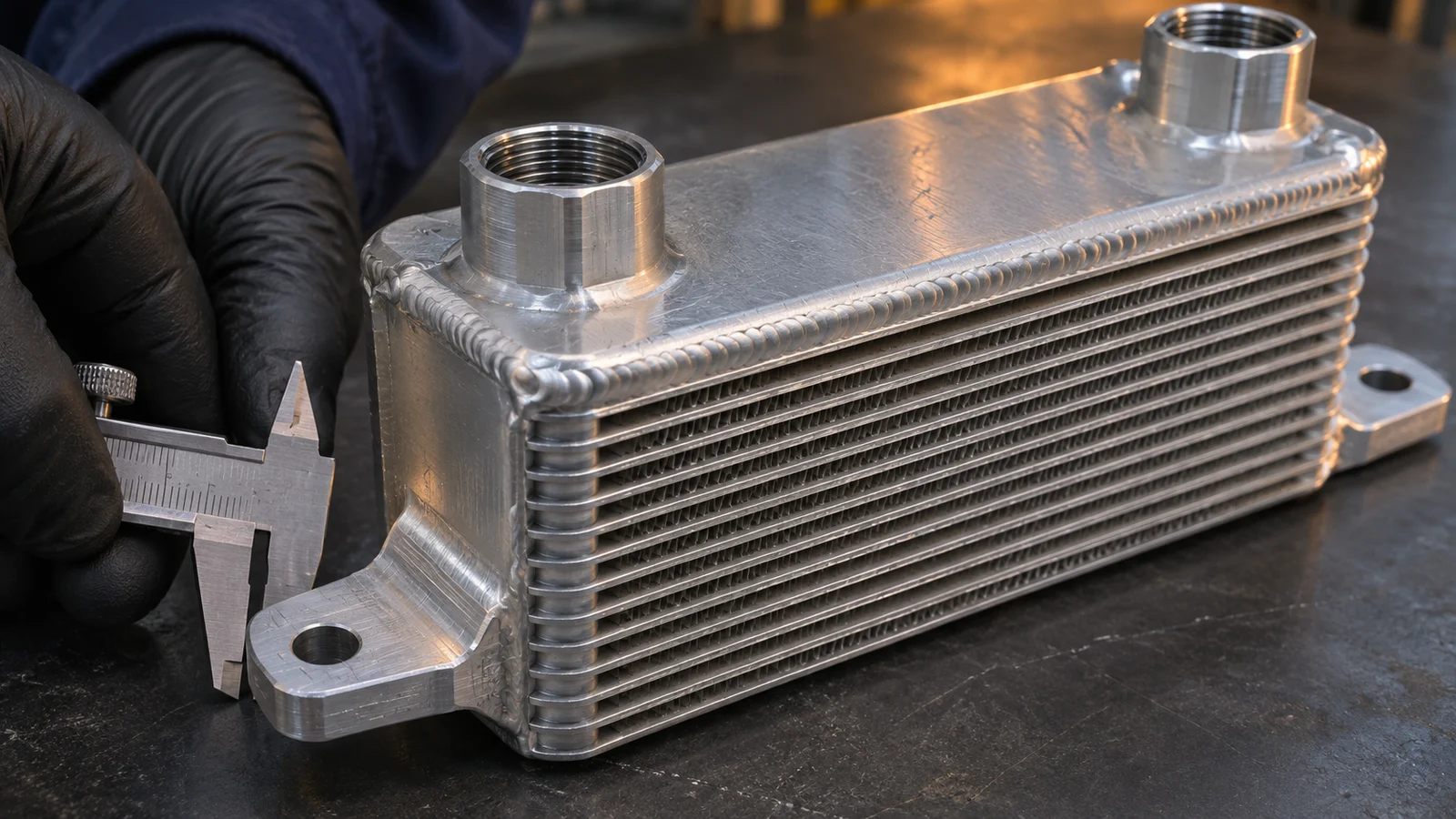
Berkeley equipment owners can contact Pankey’s in Hayward about aluminum oil cooler cleaning and repair. Identify the cooler and equipment, document welded seams, ports, fins and mounts and report contamination before discussing repairability.
Aluminum oil coolers can be compact, light and integrated into crowded equipment packages. The same construction that saves space can make identification and damage context important. A bright wet mark near a weld does not tell the whole story.
This guide helps Berkeley industrial operators prepare a focused component inquiry. It does not claim every aluminum cooler can be repaired or that Pankey’s has a Berkeley branch.
Who services aluminum oil coolers near Berkeley?
Choose a shop that lists aluminum oil cooler work and confirm the actual component. An aluminum charge air cooler, engine radiator and oil cooler can share a finned appearance but serve different circuits and require different information.
Pankey’s lists aluminum oil cooler service from its Hayward location. Berkeley businesses can contact that shop, but no Berkeley branch, mobile service or logistics are promised.
Provide the equipment type, cooler markings, dimensions, port positions, mounting tabs and overall photographs. Say which fluid the cooler carries and what flows on the other side when it is a liquid-to-liquid design.
Report whether the concern is leakage, damaged fins, a cracked weld, distorted mount, contamination or reduced performance. State how the problem was observed and what remains uncertain.
Identify who handles machine diagnosis, system isolation, removal and reinstallation. Component assessment cannot confirm that the wider oil or cooling circuit is safe and clean.
Can a damaged aluminum oil cooler be repaired?
Aluminum cooler repair depends on alloy, construction, defect location, access and remaining condition. A damaged mounting tab may present a different risk from a leak in a header, tube or inaccessible core joint. Heat from a repair process can also matter to adjacent thin material.
Photograph the entire cooler before macro views. Show the affected weld, fin stack, ports and mounts from more than one angle. Mark orientation without scratching or applying material that could contaminate the component.
Ask what assessment is needed before a repair decision. A surface mark may be residue from a connection above it, while dye, oil or coolant can travel across fins. Do not call a weld cracked unless that has been confirmed.
Record impact, vibration or unsupported hose conditions around the cooler. If a bracket has been loading the component, repairing the cooler without correcting the installation can leave the underlying stress in place.
| Visible condition | Useful context | Assessment question |
|---|---|---|
| Wet welded seam | Fluid, source certainty and wider view | Is the seam the leak source? |
| Bent fins | Area, airflow and impact history | Is damage cosmetic or functional? |
| Cracked mount | Bracket alignment and vibration | What machine-side issue also needs attention? |
| Internal debris | Fluid and failure history | Can the component be cleaned appropriately? |
When does an aluminum oil cooler need cleaning or replacement?
Cleaning is appropriate only when the contaminant, access and material compatibility are understood. Exterior oily dirt, internal oil residue and scale from another circuit are not the same. Aggressive pressure or unsuitable chemistry can damage thin fins or aluminum surfaces.
The Alfa Laval cleaning overview demonstrates how exchanger construction and fouling affect cleaning choices. A gasketed plate exchanger is not automatically comparable to a welded aluminum oil cooler, so use the exact manufacturer’s instructions.
Replacement may be more appropriate when damage is extensive, inaccessible or accompanied by broad deterioration. Preserve the ports, dimensions, mounts and duty information so replacement comparison is based on more than outside size.
If the cooler follows a system failure, ask the equipment provider how the whole circuit will be addressed. A cleaned or replaced cooler can be recontaminated if debris remains elsewhere.
Document what cleaning or repair was actually performed. Do not record the entire machine as repaired when only a loose component was serviced.
What affects the cost of aluminum oil cooler service?
Cost depends on cooler construction, size, defect, access, contamination, testing and previous work. A mount repair, leak assessment, internal cleaning and replacement evaluation are different scopes.
Ask what can be determined from photographs and what requires the component. Confirm how findings beyond the initial request are reported and who may authorize them.
Clarify draining, capping, removal, transport and installation. This Berkeley page does not promise pickup, delivery, on-site work, a free estimate or a completion date.
Keep the cooler identity, as-found images and final service description together. If the same machine later shows high oil temperature or leakage, the team can distinguish previous component work from a new system condition.
Compare quotes only when the proposed work addresses the same condition. A low-cost exterior cleaning does not answer a confirmed leak, and a replacement price does not describe whether the current unit is repairable.
Preserve the cooler’s orientation before removal. Photograph port labels, hose routing and mounting tabs, then associate the images with the equipment ID. Aluminum coolers may have similar outside dimensions while using different port positions or internal flow paths, so this record supports both correct reinstallation and any replacement comparison.
If a crack is near a mount, ask the equipment provider to inspect the mating bracket, fasteners and clearance. A repair that restores the component can fail again if vibration, misalignment or contact remains. The radiator shop’s component assessment and the machine technician’s installation assessment should be recorded as separate but related decisions.
For contamination after a mechanical failure, define what clean means for the owner’s recovery plan. The component shop can describe its agreed cleaning work, but the equipment manufacturer or system specialist may need to set particle, flushing or filtration requirements for the complete circuit. Do not ask a visual inspection to stand in for those requirements.
On return, inspect shipping protection and compare the component with the pre-removal photographs before installation. Confirm that ports, fins and mounts were not damaged in handling. This receiving check belongs in the equipment owner’s process and prevents transport damage from being confused with the original repair condition.
If the cooler is part of a stacked package, document its position relative to the radiator, condenser or charge air cooler. Airflow restrictions and contact damage may occur between layers. An outside view of the first core does not show the condition of the faces hidden inside the stack.
Ask whether the proposed pressure or leak test, if any, is included and appropriate for the component. Do not specify test values from a generic article. The cooler’s design information and the shop’s accepted procedure should control, with results documented in the actual work record.
When comparing replacement, check more than port thread and outside dimensions. Fin density, core thickness, mounting stiffness and internal flow arrangement can affect suitability. The equipment provider should confirm application requirements rather than treating a visually close substitute as proven.
If the cooler is painted or coated, note the original finish and any areas of damage. Surface preparation and heat from repair can affect coatings, while a fresh coating can hide identification or evidence. Ask what finish work is included and what the equipment owner will handle after component service.
What questions should I ask before booking service near Berkeley?
Does Pankey’s have a Berkeley location?
No. The shop is in Hayward. Berkeley operators can contact Pankey’s about an aluminum oil cooler and confirm the accepted work and arrangements.
Can every cracked aluminum cooler be welded?
No. Alloy, location, access, thin adjacent material and overall condition affect repairability. The component needs an appropriate assessment.
Can a photo prove a welded seam is leaking?
Not always. Fluid can travel from a connection or another point. Send an overview and close-ups and describe how the source was identified.
Should I clean the cooler before calling?
Document the condition first and ask what preparation is appropriate. An unsuitable chemical or pressure can damage aluminum or remove useful evidence.
Does cooler repair solve a high oil-temperature problem?
It addresses the agreed component defect. Whole-machine diagnosis may still be needed for flow, controls, contamination or other system conditions.
How can Pankey’s help with aluminum oil coolers near Berkeley?
Pankey’s is a single Hayward shop for industrial cooling components. Mario and Paul own it. Mario is the elder and most experienced, and Paul manages estimates and the business.
Berkeley equipment owners can call with the cooler identification, fluid information, photographs and the repair question. Confirm acceptance and practical handling before moving the component.
Review Pankey’s aluminum oil cooler service article for related background, then apply the records and instructions for the actual cooler.