21805 FOOTHILL BLVD, HAYWARD, CA 94541
 1-510-581-6804
Where Can You Get Industrial Oil Cooler Cleaning Near Emeryville?
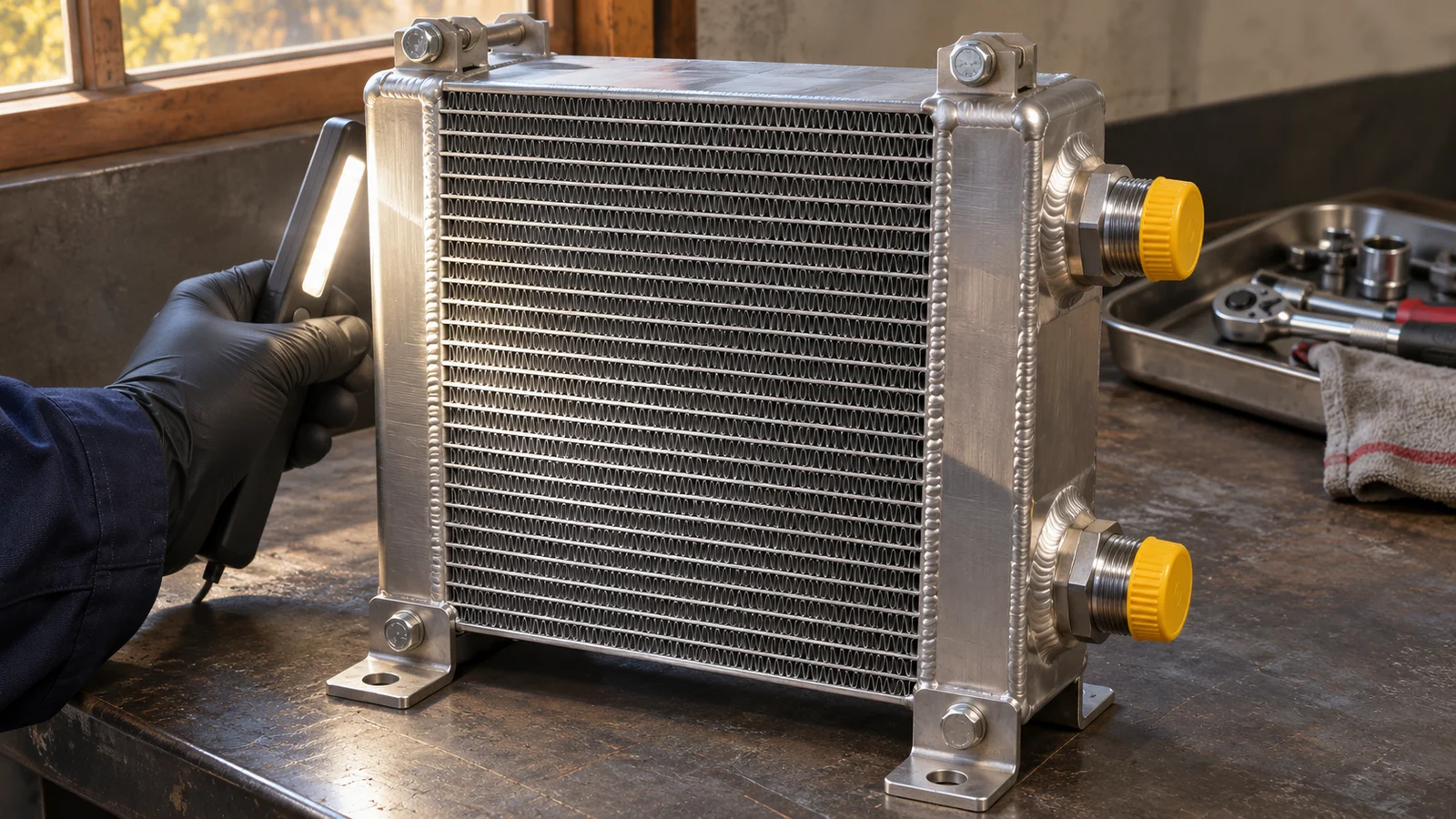
Emeryville industrial operators can contact Pankey’s in Hayward about aluminum or copper oil cooler cleaning and repair. Identify the cooler material, equipment application, oil circuit and contamination history before choosing a service scope.
An oil cooler can be dirty on the outside, restricted inside or involved in leakage between circuits. Those conditions are not interchangeable. The cleaning method and repair question depend on which surface, fluid and material are involved.
This guide helps Emeryville maintenance teams describe an industrial oil cooler without assuming a universal flush or a local branch. It covers component preparation, not complete machine diagnosis.
Who services industrial oil coolers near Emeryville?
Choose a shop that understands industrial cooling components and ask about the exact cooler. Aluminum plate-fin units, copper tube-and-shell coolers and other constructions can require different assessment and service methods.
Pankey’s lists aluminum oil cooler and copper oil cooler services from Hayward. Emeryville is not another branch, and component work does not imply machinery service at the customer site.
Provide the equipment type, cooler markings, dimensions, port layout and photographs. Identify the material only when known. Silver color does not prove an alloy, and paint or oxidation can obscure copper-brass construction.
Describe both circuits. State the oil type and the other cooling medium when known, plus any evidence of fluid mixing. Unknown residue or a process-related contaminant should be disclosed rather than cleaned away without a record.
Identify who handles system isolation, draining, decontamination, removal and reinstallation. A component cleaning discussion cannot establish that the machine is safe to open or operate.
What contamination details should I report before oil cooler cleaning?
Report where contamination appears. Exterior dust or oily film on fins affects airflow, while sludge or varnish inside oil passages affects flow and heat transfer. Scale on a coolant side is another condition. Each location leads to different compatibility questions.
Give the oil specification or product information from the equipment record, recent failure history and any known debris source. A compressor, hydraulic system or transmission failure can change what particles or fluids may be present and what the owner expects from cleaning.
Photograph the whole cooler, nameplate, ports, mounts, fin or tube surfaces and residue before it is disturbed. Cap or protect openings according to the owner’s procedures, but do not seal unknown pressure or contamination into a container without a safe plan.
EJ Bowman’s heat exchanger FAQ illustrates how cleaning access and methods depend on exchanger construction. Use the actual cooler manufacturer’s instructions and material information; the source does not define Pankey’s capabilities for every unit.
| Contamination report | Detail to include | Do not assume |
|---|---|---|
| Dust on external fins | Coverage, oiliness and fin condition | Internal passages are clean |
| Dark residue in oil port | Oil type and failure history | Composition from color |
| Scale on coolant side | Coolant history and material | Any chemical is compatible |
| Mixed fluids | Which circuit changed and how confirmed | Cleaning alone repairs the leak |
Can industrial oil coolers be repaired instead of replaced?
Repairability depends on construction, location and remaining condition. A cracked aluminum seam, damaged mounting tab, leaking copper joint and internally compromised tube present different options. Do not generalize from one cooler material to another.
Ask what inspection or testing supports the recommendation. Cleaning may be required before a defect can be evaluated, but it should not be represented as a repair. If cross-circuit leakage is suspected, the scope should state how that question is assessed.
Replacement comparison requires port sizes and positions, mounting geometry, dimensions and application requirements. A cooler that fits the space may still be wrong for the fluids, connections or duty.
Record nearby causes of damage such as unsupported hoses, vibration, impact or fan contact. Component repair does not correct a machine-side condition that can damage the cooler again.
After work, the equipment provider remains responsible for system flushing decisions, filtration, refill, leak checks and operation. A clean component cannot guarantee that the rest of a contaminated circuit is clean.
What affects the cost of industrial oil cooler service?
Cost begins with the defined cooler and service scope. Size, construction, contamination, cleaning access, damage, testing and previous work can all matter. Hazardous or process contamination may add owner responsibilities before the shop can accept the component.
Ask what can be determined from identification and photos, what requires the cooler and how changed findings are authorized. One maintenance contact should own the approval and answer process questions.
Confirm draining, capping, transport and reinstallation responsibilities. This Emeryville article does not promise pickup, delivery, on-site work, a free estimate or a turnaround time.
Keep the as-found photos, contamination history and final work description with the machine record. If a system failure generated debris, the record should show that cooler service was one part of a broader recovery plan.
Compare like scopes. Exterior cleaning, internal cleaning, leak repair and replacement are not equivalent quotes even when each uses the words oil cooler service.
Create a contamination handoff that names the machine event as well as the cooler. For example, record whether the cooler was removed after a hydraulic pump failure, compressor problem or routine inspection. That history can change the owner’s cleaning objective and the need for system-level filtration or flushing decisions outside the cooler shop.
If the cooler has two liquid circuits, label the ports before disconnection and keep caps associated with the correct side. Mixing oil-side and coolant-side residue during handling can make later observations harder to interpret. The owner’s maintenance provider should control this labeling and preserve any samples under its procedures.
Do not judge cleanliness solely by the appearance of a port opening. Narrow passages can retain contamination that is not visible from the connection, while an exterior stain can remain after the active source is gone. Ask what the proposed method can verify and what uncertainty remains after cleaning.
When the cooler returns, the installation record should note direction, supports, hose condition and any torque or seal requirements from the actual equipment documentation. Correct component work can still be undermined by a misrouted hose, unsupported connection or contaminated system, so the wider maintenance provider must own those checks.
If samples or filters show particles, preserve the findings from the qualified maintenance team. Size, material and source may influence the owner’s recovery plan, but the radiator shop should not be asked to identify unknown debris from a phone photograph. State what has been confirmed and what analysis is still pending.
A cooler removed from production equipment should carry a clear asset tag and port map through transport. This reduces the chance that caps, adapters or brackets are switched with another unit and makes it easier to compare the returned component with the original installation images.
When discussing internal cleaning, ask how the scope addresses inaccessible passages and what result can actually be verified. A statement that fluid passed through the cooler is not necessarily the same as a cleanliness standard for the whole machine circuit. Define expectations with the responsible system provider.
Before authorizing transport, confirm that the cooler is drained, identified and packaged in a way that protects fins and ports. A bent mounting tab or crushed fin area introduced during handling can create a new condition and confuse the as-found record.
What questions should I ask before booking service near Emeryville?
Does Pankey’s have an Emeryville shop?
No. Pankey’s is at 21805 Foothill Blvd in Hayward. Emeryville businesses can contact that shop about an industrial oil cooler.
Is external fin cleaning the same as internal cleaning?
No. Exterior airflow surfaces and internal fluid passages present different contaminants, access and material-compatibility questions.
Should I report the oil type?
Yes. Provide the known oil or fluid specification, other circuit medium and relevant failure or contamination history. Do not guess unknown residue.
Can cleaning fix oil and coolant mixing?
Cleaning does not by itself repair a cross-circuit leak. Describe how mixing was identified and ask what assessment and repair questions apply.
Does cooler service clean the entire machine circuit?
Not automatically. Component work and whole-system flushing, filtration, refill and diagnosis are separate responsibilities that must be assigned.
How can Pankey’s help with industrial oil coolers near Emeryville?
Pankey’s is a Hayward industrial cooling-component shop owned by Mario and Paul. Mario is the elder and most experienced, and Paul is the estimator and general manager.
Emeryville operators can call with the cooler identity, material, circuit information and contamination history. Confirm preparation, service scope and handling before moving the component.
Related background is available in Pankey’s aluminum oil cooler article and copper oil cooler article. Use the page matching the actual construction.