 21805 FOOTHILL BLVD, HAYWARD, CA 94541
 1-510-581-6804
Bent Charge Air Cooler Fins: When Airflow Damage Needs Attention
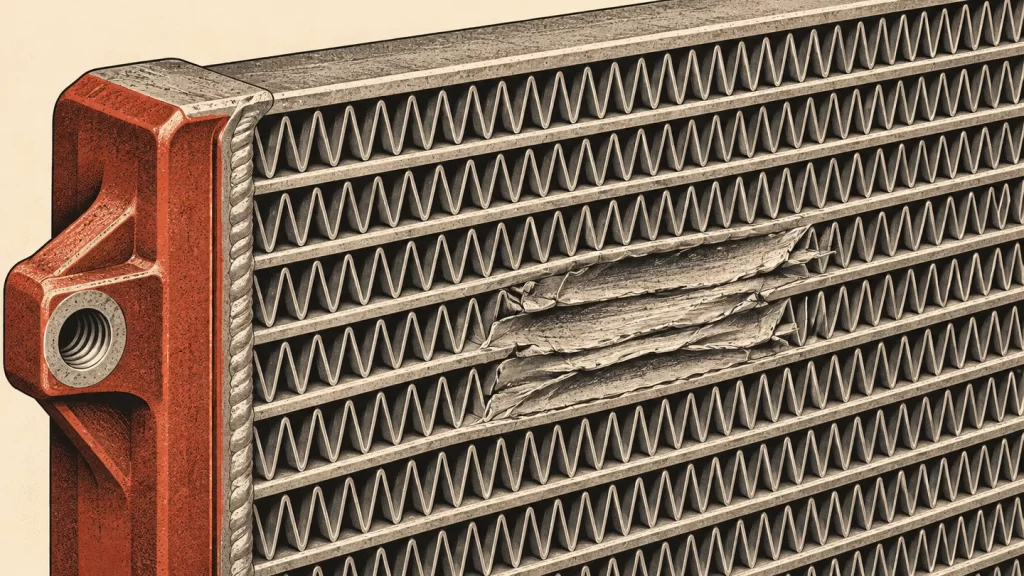
What do the fins on a charge air cooler do?
Fins help move heat from the compressed air inside the cooler to the outside air flowing through the cooling stack.
The internal passages carry charge air. External fins create more surface area to transfer heat between those passages and the outside airstream. Caterpillar’s description of its 180-8689 air-to-air aftercooler core explains the role of fins in transferring heat from the tubes. Actual fin geometry and cooling stack layout vary by equipment. A core at the front of one machine may be positioned differently on another.
An isolated folded fin and a broad area of crushed fins have different implications. The useful observation is the pattern: where the damage begins, how much of the face appears affected and whether the passage between rows is visibly open. If a separate cooler or screen covers part of the face, photograph that relationship and note which areas you can see. Avoid estimating overall coverage from a single close-up.
The machine’s operation gives the observation context. A cooler in a dusty work area may have packed material in the stack as well as folded fins. Road debris can affect the exposed face of a commercial truck’s cooling module. If the problem arose after a strike or recent work, include that history with the images.
Keep the photos in order if the damage developed across several shifts. Compare the same area and angle where possible. That record helps the technician see whether a patch is growing or whether debris returns in the same part of the stack after cleaning.
When do bent fins point to a meaningful airflow restriction?
The extent, location and surrounding condition tell a more useful story than a close-up of a few damaged fins alone.
Look for visible patterns from a safe position with equipment secured. A wide flattened patch, several rows filled with debris or damage aligned across multiple layers of the stack deserves specific documentation. Report a scrape or deformation near a tube separately. If a guard is damaged or a support looks displaced, include a photo of its relationship to the core. A repeated contact point may matter for avoiding more damage after component work.
| What you can see | What to document for the service discussion |
|---|---|
| A few folded fins with open rows around them | A close-up and a full-face photo that show the area in proportion |
| A wide patch of collapsed fins or compacted debris | Its location, nearby layers and the conditions when any temperature change appeared |
| A scrape, puncture or deformation near a tube or tank | Where it sits in relation to the ports and any separate leak findings |
| A shifted shroud, guard or mount | The clearances visible in a wide photo and any known impact or recent removal |
There is no universal visual cutoff. Core design, stack configuration and operating demand affect the next step. Ask the equipment technician to connect the observed condition with the machine’s performance and inspection criteria before choosing work.
How are bent fins different from a charge air leak?
The fins and the pressure boundary do different jobs, so airflow damage and air leakage need to be evaluated separately.
Fins may be bent while the tubes still hold air. A struck tube, seam or port raises a separate integrity question. Likewise, an apparently straight fin face can coexist with a leak in a flexible connection elsewhere. Keep two lines in your notes: outside airflow condition and charge air leak evidence. Write “not assessed” when you lack a result.
If the operator says “it runs hot,” ask what the instrument actually displayed. A coolant temperature warning and a technician’s charge air temperature measurement come from different systems. Both can matter in a shared stack, but label each record and note the operating load. If someone performed a leak check, record the test boundary and exact component finding alongside the fin photos.
A photo taken straight on can show how broad the affected area is. A second at an angle can make flattened rows easier to see. If there’s a label or part number, collect it separately. The purpose is to show conditions to the right technician, and the photos should be taken without opening guarded areas or reaching into the stack.
How should you discuss cleaning, fin damage and core condition?
Start with the manufacturer’s instructions and ask which work addresses the visible issue and what should be assessed separately first.
The Detroit Gen 5 DD platform operator manual describes periodic exterior buildup checks for its charge air cooler. Treat that as guidance for the identified application. Other equipment can have different access, construction and cleaning restrictions. A damaged or impacted core deserves assessment before anyone tries to straighten it or applies tools or a high-force stream to the fins. Thin fin material and neighboring parts can be damaged further by the wrong approach.
If cleaning is proposed, ask which surfaces are included and whether the technician can see between stack layers. If there is possible impact damage, ask which nearby tubes, mounts or connections also need attention. Record who will evaluate the assembly when the work is complete and what they will use to assess the original complaint.
A useful work order might read, “Outside rows appear packed in the lower right, plus a bent corner near the support. Operator reported a coolant-temperature warning only under sustained load. Charge air leak status unknown.” That tells the reader which facts are established and which checks remain open.
What do owners ask about bent charge air cooler fins?
These questions help you decide what to photograph and explain to the service team before cleaning or removing the cooler.
Do a few bent fins always mean the cooler needs replacement?
The extent, location and surrounding condition matter. Ask a qualified technician to assess the identified part if you see broad blockage, tube damage or a related operating complaint.
Can a cooler hold air with damaged fins?
Yes. Fin condition affects heat transfer and external airflow. An appropriate leak check assesses the pressure boundary within its defined scope.
Can I tell whether the cooler is restricted from one photo?
One image can document a visible patch. A full view, another angle and the equipment’s operating history give the technician better context.
Should I straighten the fins before calling?
Record the original damage. Ask what the equipment maker allows and let the responsible technician assess whether fin work would be appropriate.
How can Pankey’s help with a damaged cooler core?
Give the Hayward shop the full cooling stack photo and tell them which part and which condition need attention first.
Pankey’s lists charge air cooler services for industrial equipment. Share the component number, pictures of the damage and any documented leak findings when you call. Tell the shop whether the cooler remains installed and what your equipment technician is investigating. Ask what assessment or cleaning can be considered for your particular unit and confirm arrangements before moving it.
