21805 FOOTHILL BLVD, HAYWARD, CA 94541
 1-510-581-6804
Who Repairs Charge Air Coolers Near Milpitas?
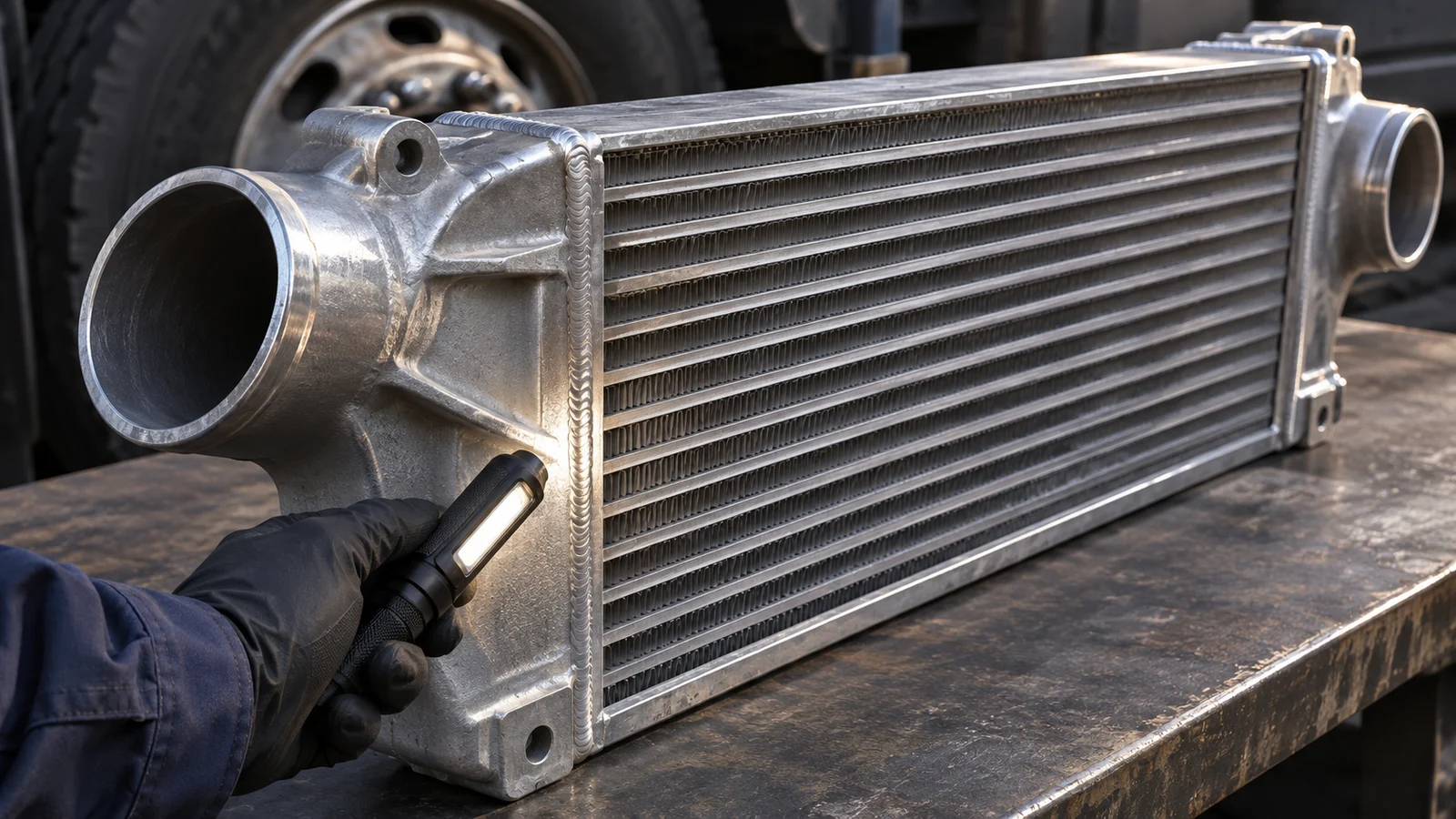
Milpitas commercial equipment operators can contact Pankey’s in Hayward about charge air cooler cleaning and repair. Identify the cooler, document its large air ports, seams and mounts and separate core leak evidence from boot, clamp or duct concerns.
A charge air cooler is not the engine-coolant radiator. It cools compressed intake air and is connected by ducts, boots and clamps. A boost leak can occur at the cooler or in those connections, so the service inquiry should not begin by assuming the core is defective.
This guide helps Milpitas fleets and equipment teams organize the component evidence. It does not claim complete engine diagnosis, roadside service or a local branch.
Who services charge air coolers near Milpitas?
Choose a shop that lists charge air cooler work and state the component clearly. The cooler may sit in front of or beside the radiator, but it carries pressurized intake air rather than engine coolant.
Pankey’s lists charge air cooler service from Hayward. Milpitas operators can contact that location, but no Milpitas branch, pickup or roadside work is promised.
Provide the vehicle or machine identity, cooler markings, overall dimensions, port sizes, mounting points and installed photographs. Note whether the unit is original or a prior replacement.
Describe the symptom: loss of power, noise, visible oil mist, damaged fins, impact, loose connection or a test result from a qualified provider. Do not convert a performance complaint into a confirmed core leak without evidence.
Confirm who handles engine and intake-system diagnosis, cooler removal and reinstallation. Component work is only one part of the complete air path.
Is the boost leak in the charge air cooler or its connections?
Inspect the air path safely under the equipment’s procedures. Photograph boots, clamps, ducts and both cooler ports along with the core, tanks, welded seams and mounts. A loose clamp can create a symptom that resembles a cooler leak.
The Detroit Diesel operator guidance includes checking the charge air cooler and connecting air ducts for condition and debris. Use the actual equipment manual and qualified test procedure rather than applying one model’s details universally.
Oil film can appear in intake plumbing, but appearance alone does not establish whether a cooler is leaking or what another engine condition may be. Report location, extent and who observed it.
If a leak test has been performed, provide the test method and result from the responsible technician. Do not invent or borrow a pressure value from an online article. The component’s specifications and accepted shop procedure should control.
| Evidence | Possible location to clarify | Do not assume |
|---|---|---|
| Hiss under load | Boot, clamp, duct or cooler | The core is confirmed leaking |
| Oil mist near port | Connection and intake path | The seam is the source |
| Bent fins | Core face and impact context | Air leakage from fin appearance |
| Cracked mount | Bracket, alignment and vibration | Repair alone corrects external stress |
Can charge air coolers be repaired instead of replaced?
Repairability depends on construction, defect location, access and overall condition. A localized welded seam or tank concern differs from broad core damage, distorted ports or a cooler with several prior repairs.
Ask what assessment or testing supports the proposed repair. If the cooler is repaired, the engine provider should still inspect boots, clamps, ducts and the wider intake system before return to service.
Cleaning is a separate scope. External debris may restrict airflow, while internal oil residue raises different handling questions. A cleaning method must suit thin fins and aluminum construction.
Replacement comparison requires port geometry, dimensions, mounts, flow orientation and application information. A cooler that fits between the frame rails is not automatically correct.
Document machine-side contact or vibration. A repaired mount can be damaged again if the supporting bracket remains misaligned or loose.
What affects the cost of charge air cooler service?
Cost depends on cooler size, construction, defect, contamination, testing and previous work. A connection issue, exterior cleaning, core leak repair and replacement are different scopes.
Ask what the shop can determine from the initial record and what requires the loose component. Confirm how changed findings are communicated and approved.
Clarify removal, port protection, transport and reinstallation. This Milpitas guide does not promise mobile work, pickup, delivery, a free estimate or turnaround.
Keep the as-found intake-path photos with the final component description. If the performance complaint remains, the engine technician can see exactly what the cooler shop addressed.
Compare like scopes and keep test expectations explicit. Do not compare a boot replacement by another provider with a cooler repair as though they answer the same defect.
Preserve the charge air cooler’s orientation and port relationship before removal. Label left and right as installed, show the route of each duct and record bracket spacers or isolators. Once the cooler is on a bench, those installation clues can be lost, making it harder to evaluate repeated contact or misalignment.
Inspect connection hardware through the responsible equipment provider. A boot may be oil-softened, a clamp may be positioned poorly or a duct may be distorted. Those findings do not prove the cooler is good or bad, but they shape the system-side work that must accompany any component decision.
If a qualified technician reports a leak-test result, keep the test conditions with the number. Temperature, sealing method and the ports included can affect interpretation. A bare pressure value copied into an email without the component specification or procedure is not a reliable service record.
After cleaning or repair, protect the ports from dirt and damage during transport. Do not use the port necks as handles or lifting points. On return, compare the tanks, fins, welds and mounts with the handoff photographs before installation so shipping damage is not confused with the original defect.
When the equipment returns to service, the engine or fleet technician should verify boots, clamps, ducts, clearances and the complete intake system under the actual manufacturer procedure. Record the cooler work exactly. A note saying boost problem fixed can overstate what a component shop actually completed.
If performance symptoms continue, use the preserved record to guide the next diagnostic step rather than repeating the cooler repair. The earlier photographs and test receipts can show whether the same connection changed, a new leak appeared or the original complaint was never isolated to the cooler.
For coolers in stacked modules, document hidden core faces and the order of removal. Debris trapped between the charge air cooler and radiator can affect airflow while remaining invisible from the front. Cleaning the first visible face does not establish that the stack is clear.
If fins are bent, record the size and location of the affected area without attempting to straighten them for the photograph. Fin damage can be cosmetic, airflow-related or associated with deeper impact. The shop needs the undisturbed context to frame the assessment.
Keep cooler identification with any replacement comparison. Port diameter, angle, tank design, mounts and core thickness can differ within an equipment family. The responsible equipment provider should confirm application compatibility before a substitute is approved.
Retain the original cooler until fit, connections and installation responsibilities are resolved. Its geometry is valuable evidence.
What questions should I ask before booking service near Milpitas?
Is a charge air cooler the same as a radiator?
No. A charge air cooler cools compressed intake air, while the engine radiator carries coolant. They can be adjacent but serve different circuits.
Does Pankey’s have a Milpitas location?
No. Pankey’s is in Hayward. Milpitas operators can contact the shop about a charge air cooler and confirm arrangements.
Can a loose boot cause a boost leak?
A boot, clamp or duct can be part of the air-path concern. Inspect and document connections rather than assuming the cooler core is the source.
Should I pressure-test the cooler from an online value?
No. Use the component specification and a qualified, accepted procedure. Do not borrow test pressure from an unrelated model or article.
Does cooler repair include engine diagnosis?
Not automatically. Cooler component work and complete intake, turbocharger or engine diagnosis are separate responsibilities that must be confirmed.
How can Pankey’s help with charge air coolers near Milpitas?
Pankey’s is one Hayward industrial cooling shop owned by Mario and Paul. Mario is the elder and most experienced, and Paul is the estimator and general manager.
Milpitas fleets can call with the equipment and cooler identity, connection photos and any qualified test information. Confirm the component scope before removal or transport.
Pankey’s charge air cooler guide provides related background. Use the exact equipment manual and agreed service scope for decisions.