21805 FOOTHILL BLVD, HAYWARD, CA 94541
 1-510-581-6804
Where Can You Get a Leaking Heavy-Duty Radiator Assessed Near San Lorenzo?
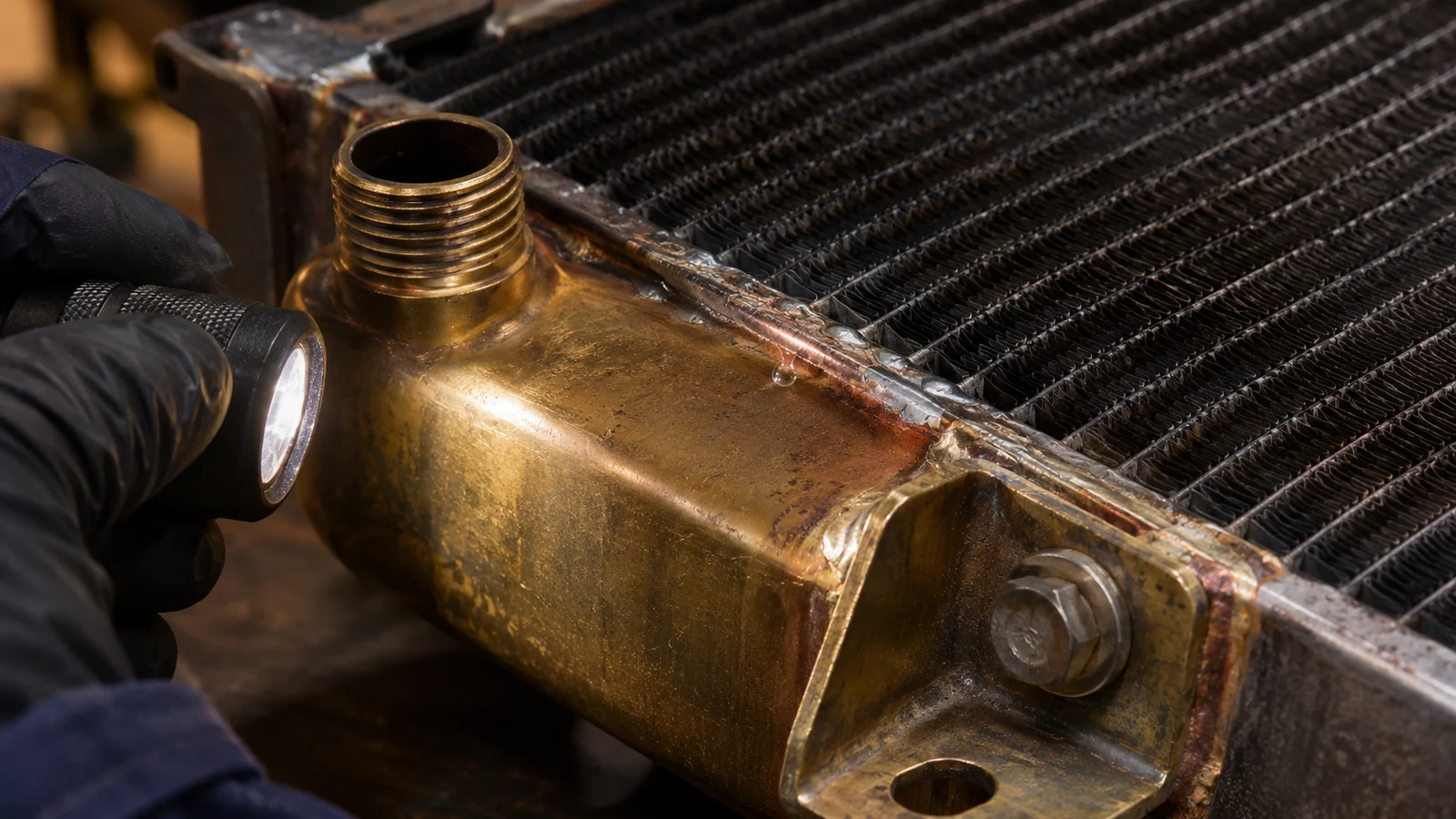
San Lorenzo equipment owners can contact Pankey’s in Hayward about a heavy-duty radiator leak assessment. Record when fluid appears, where it is first observed, the radiator identity and nearby hoses, tanks, seams and mounts without assuming the nearest wet area is the source.
Coolant can travel along a hose, tank, frame or airflow path before it drips. A wet seam may be the source, but it may also be the place where fluid collects. A good leak inquiry preserves uncertainty until evidence supports the repair decision.
This guide focuses on industrial equipment and commercial machinery near San Lorenzo. It does not cover passenger cars or promise a diagnosis, price or mobile service from a photograph.
Who services heavy-duty radiators near San Lorenzo?
Choose a shop that lists heavy-duty industrial radiator work and explain the equipment. A commercial truck, loader, generator and drill rig can use different radiator constructions and require different removal coordination.
Pankey’s lists heavy-duty radiator service from Hayward. San Lorenzo operators can contact that shop, but no San Lorenzo branch, roadside work, pickup or delivery is implied.
Provide the machine or fleet unit, radiator markings, installed or removed status and recent service history. Note coolant additions and operator warnings without continuing to run unsafe equipment to reproduce the leak.
Photograph the whole radiator and cooling package before close-ups. Include hoses, clamps, filler area, tanks, seams, core, drain, mounts and the path below the wet area.
Confirm who diagnoses the complete machine. A radiator assessment cannot automatically rule out hose, pump, engine or other cooling-system problems.
What should I report before a heavy-duty radiator leak assessment?
Record when the leak appears: cold, warming, under load, after shutdown or continuously. State whether the system was recently serviced and whether residue is fresh, dried or cleaned away. Do not open a hot pressurized system for observation.
Describe the fluid by known system context rather than color alone. Different coolants, contamination and lighting can change appearance. Unknown fluid should remain unknown until the appropriate provider identifies it.
Show connections above and beside the wet spot. Fluid can run downward or be moved by the fan. A wider view makes a close-up of a tank seam more meaningful.
Caterpillar’s radiator guidance directs owners to the machine manual for safe maintenance. Use the actual equipment instructions and do not apply high pressure or unsafe access to reveal a leak.
| Observation | Record | Do not conclude yet |
|---|---|---|
| Wet tank seam | Hoses, cap and area above | The seam is the source |
| Drip after shutdown | Timing and temperature history | Repair type or price |
| Dried residue on fins | Pattern and nearby connections | The core is leaking |
| Coolant loss with no visible drip | Amount, interval and machine symptoms | The radiator is the only cause |
Can heavy-duty radiators be repaired instead of replaced?
Repairability depends on the confirmed defect, radiator construction and remaining condition. A localized tank or joint issue differs from widespread core deterioration, impact damage or repeated failures around a stressed mount.
Ask what assessment or testing is needed to locate the leak and what the proposed repair addresses. A photograph may identify an area of interest but cannot reveal every internal or pressure-dependent condition.
If cleaning is needed to expose the source, confirm how new findings will be reported. Cleaning is not a repair and may reveal additional defects hidden by residue.
If replacement is considered, preserve dimensions, connections, mounts and identification. A machine model or visually similar core is not proof of fit.
Record bracket, shroud or vibration concerns. Component repair should not hide an external condition that could cause the same damage again.
What affects the cost of heavy-duty radiator service?
Cost follows the assessment and scope. Size, construction, leak location, condition, contamination, testing, previous work and parts can all matter. A wet spot cannot support a responsible price by itself.
Ask what the shop needs for an initial discussion, what requires the component and how additional findings would be authorized. Identify one decision-maker for the equipment owner.
Confirm draining, removal, transport and reinstallation responsibilities. This San Lorenzo article does not promise on-site work, pickup, delivery, a free estimate or turnaround.
If the machine is needed urgently, state the constraint without asking for a guarantee before the radiator is identified and assessed.
Keep as-found photos, test information and the final work description together. If fluid loss returns, the maintenance team can compare the new condition with the exact defect addressed.
If coolant residue has dried across a large area, photograph the pattern before wiping it. The direction of streaking, nearby airflow and connection position may help frame the assessment, even though the pattern alone cannot prove the source. Keep cleaned and as-found images clearly labeled.
A maintenance team can use absorbent material or other approved observation methods only under its safe procedure. Do not introduce dyes, sealers or chemicals solely to create evidence unless the equipment manufacturer and responsible provider approve them. Additives can alter the system and complicate later assessment.
When a leak appears only under load or after shutdown, retain the operator’s timing notes and instrument readings. Do not ask the operator to repeat unsafe conditions. The shop can explain what component information is needed, while the machine provider decides whether and how further system testing occurs.
Before removal, label hoses, ports, mounts and shroud relationship. Fluid at a connection can be disturbed during disassembly and erase useful evidence, so pair the removal record with the original photographs. This also supports correct reinstallation after component work.
If a previous repair exists near the wet area, include that history and date. The current assessment may need to consider the surrounding material and repeated stress, not just the newest visible point. Do not hide earlier work under fresh paint or cleaning before the shop sees the record.
After the radiator returns, inspect transport condition and compare it with the original images. The equipment provider should then install, refill, vent and test the complete system under the machine instructions. A component repair receipt should not be treated as permission to skip those steps.
If the leak is intermittent, keep a simple log of coolant additions and observations by date and operating condition. Do not rely on memory or describe the loss as constant when it occurred only once. A factual timeline can help separate a slow component concern from an unrelated spill or service event.
Protect the removed radiator’s ports and core during transport. Do not strap across delicate fins or use filler necks as handles. Photograph the packaged unit and its condition at handoff so damage introduced in transport is not attributed to the original leak.
When the shop reports findings, update the source description. If the wet seam was only a collection point and the leak came from a connection, preserve that correction. Accurate records prevent a future technician from repeating the original assumption.
If no leak is found under the agreed assessment, record that result without claiming the entire cooling system is leak-free. Intermittent machine conditions and other components may require further diagnosis by the responsible equipment provider using the correct documented procedures.
What questions should I ask before booking service near San Lorenzo?
Does Pankey’s have a San Lorenzo location?
No. Pankey’s is in Hayward. San Lorenzo equipment owners can contact the shop about a heavy-duty radiator and confirm arrangements.
Can a photo identify the exact leak source?
It can show an area of concern, but fluid can travel from another connection. An overview, close-ups and an appropriate assessment may be needed.
Should I run the machine to make the leak visible?
Follow the equipment instructions and safe shutdown procedures. Do not operate unsafe equipment or open a hot pressurized system to create evidence.
Can a leaking radiator always be repaired?
No. Repairability depends on the defect, construction and overall condition. The component requires an appropriate assessment.
Does radiator repair fix every coolant-loss problem?
It addresses the agreed radiator defect. Hoses, pump, engine and other cooling-system conditions may require separate diagnosis.
How can Pankey’s help with heavy-duty radiators near San Lorenzo?
Pankey’s is one Hayward industrial cooling-component shop. Mario and Paul own the business. Mario is the elder and most experienced, and Paul handles estimates and general management.
San Lorenzo equipment owners can call with the machine and radiator identity, leak timing, photographs and source certainty. Ask what assessment fits before moving the component.
The heavy-duty radiator guide provides broader background. Use it to organize the inquiry, not to diagnose the leak from a distance.