21805 FOOTHILL BLVD, HAYWARD, CA 94541
 1-510-581-6804
Where Can You Get Forklift Radiator Repair Near Union City?
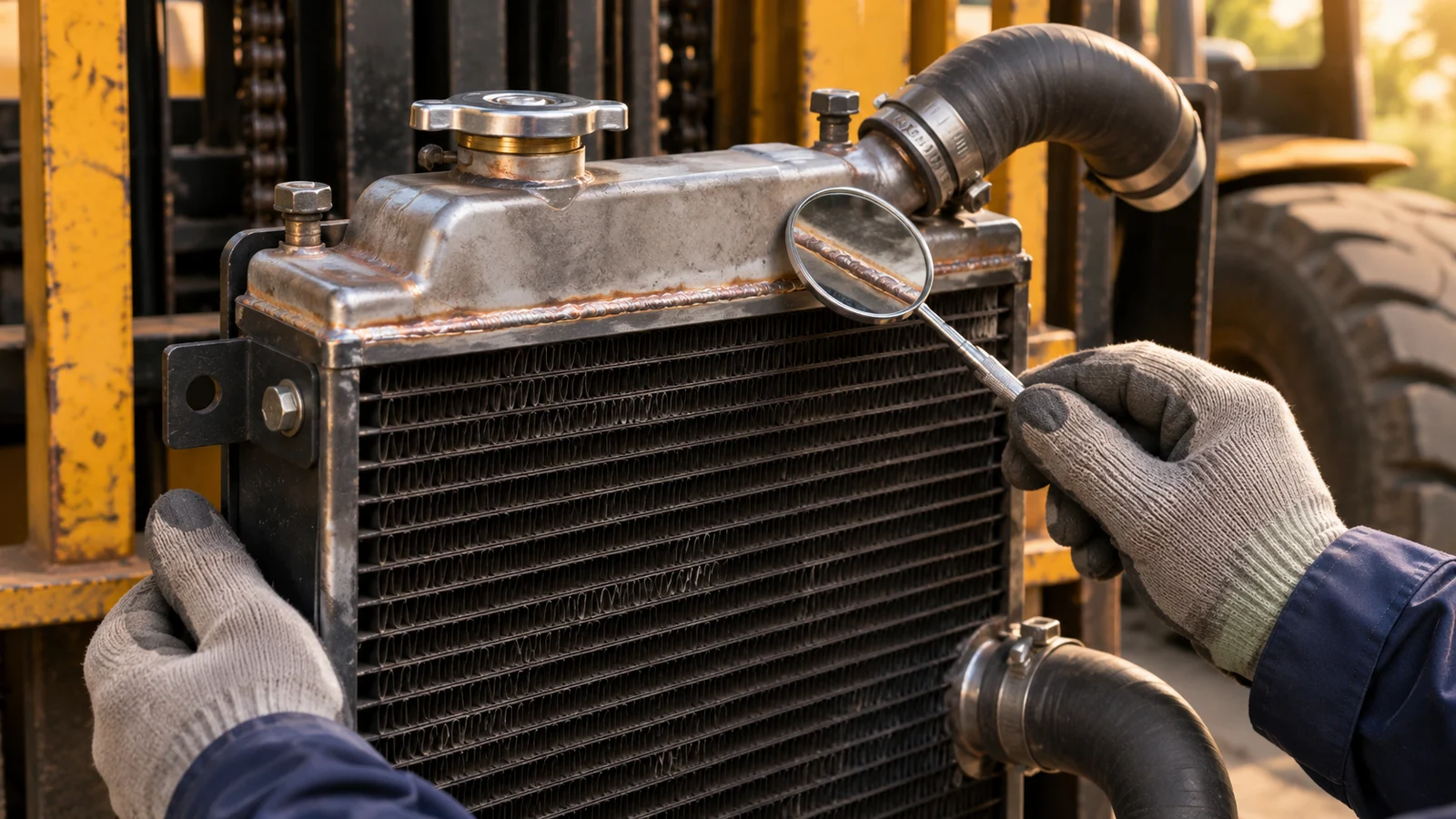
Union City businesses can contact Pankey’s in Hayward about industrial forklift radiator cleaning and repair. Identify the forklift and installed radiator, report the operating pattern and confirm whether the question is airflow blockage, leakage or broader machine diagnosis.
Forklifts often work where packaging fibers, dust and fine debris can collect around a compact cooling package. When a machine begins running hot, it is tempting to label the radiator as dirty before checking what is actually visible and when the symptom occurs.
A stronger service request separates observations from conclusions. This guide is for industrial and commercial forklift radiators near Union City. It does not cover passenger cars, promise mobile service or assume that every forklift has the same cooling layout.
Who services forklift radiators near Union City?
Choose a shop by the equipment and component scope, not by the word radiator alone. A forklift service inquiry can involve an installed compact radiator, a cooling package with several sections or a loose component that maintenance has already removed. State which situation applies.
Pankey’s lists industrial forklift radiator service from its Hayward shop at 21805 Foothill Blvd. Union City is part of the local service conversation, but the article does not represent a Union City branch or promise jobsite attendance.
Give the forklift manufacturer, model, serial or fleet identifier and fuel or power configuration relevant to your records. Then add radiator markings and clear photographs. A replacement installed in the past may not match what a model-only lookup suggests.
Explain whether the concern appears during long travel, lifting cycles, idling or a particular shift environment. Mention warning lights, coolant additions and recent maintenance. Keep operator observations distinct from a technician’s confirmed findings.
Ask whether the shop is discussing a radiator component or the whole machine. Fan operation, belts, coolant circulation and other systems can affect temperature behavior. A component service scope should not be treated as a complete forklift diagnosis.
Can a blocked forklift radiator cause overheating?
Blocked external airflow can contribute to heat rejection problems, but visible debris is only one part of the record. Note what material is present, where it collects and whether the core face is accessible. Fibers packed between stacked coolers may not be obvious from the outer grille.
Follow the forklift’s maintenance and lockout instructions before opening panels or approaching a fan. Do not use compressed air, water or tools simply because a generic article mentions cleaning. Pressure, direction, material and access all affect whether a method can damage fins or push debris deeper.
Caterpillar’s radiator maintenance guidance advises owners to consult their operation and maintenance manual and warns that high-pressure water can damage fins. Apply the manual for the actual forklift and installed component.
Photograph the whole cooling package before close-ups. Show the core face, nearby cooler sections, shroud, mounts and any area where debris returns quickly. If the forklift works in a dusty warehouse, recycling yard or other demanding environment, describe the exposure without claiming it proves the cause.
| Observation | Record next | Question for service |
|---|---|---|
| Lint across the face | Coverage and adjacent layers | What cleaning scope suits the assembly? |
| Temperature rises on one shift | Load, duration and environment | Is more machine diagnosis needed? |
| Wetness near a hose | Connection and source certainty | Which component should be assessed? |
| Bent fins or contact marks | Mounts, guard and wider context | Is there repairable component damage? |
Can forklift radiators be repaired instead of replaced?
Some forklift radiators may be candidates for repair, but the answer depends on the construction, damaged area and condition of the rest of the assembly. A local seam concern is different from widespread corrosion, impact damage or a core with several compromised areas.
Ask which defect the proposed repair addresses and what the assessment can establish. If a bracket or shroud has contacted the radiator, record that installation condition. Repairing the component alone does not correct a loose support or recurring contact elsewhere on the machine.
Cleaning and repair should stay separate in the scope. Removing external debris does not repair a leak. Repairing a tank or joint does not establish that airflow is clear through every layer. Internal contamination raises another set of material and circuit questions.
If replacement becomes the practical discussion, confirm dimensions, mounting points, hose connections and any integrated sections. Forklift model information helps, but direct identification of the installed radiator reduces the risk of comparing the wrong configuration.
Do not approve work from a single close-up if the shop requests more context. A compact assembly can hide damage or contamination on the side that is difficult to photograph while installed.
What affects the cost of forklift radiator service?
The cost depends on what is actually being considered. Component size, construction, condition, contamination and previous work can affect cleaning or repair. Installed access and coordination with the forklift maintenance provider may affect the overall project even when those tasks are outside the radiator work.
Ask what the preliminary information can support and what requires an in-person component assessment. Clarify how additional findings would be communicated and who can authorize changes. For a warehouse fleet, label each record by unit so similar machines do not get mixed.
Confirm removal, transport and reinstallation responsibilities directly. A local article does not include pickup, delivery, on-site service or a free estimate. The shop must define the accepted work and arrangements for the particular radiator.
If the forklift is important to a scheduled operation, explain the constraint while avoiding an assumed turnaround. A reliable plan needs the shop’s assessment of the actual component and agreed scope.
Keep the final work description with the forklift’s maintenance record. Note the radiator identification and the original symptom so future teams can distinguish recurring equipment behavior from a new component problem.
For multi-shift operations, record who observed the symptom and who can answer follow-up questions. The operator who saw the warning may not be the technician who inspected the radiator. Keeping those observations attributed prevents a later estimate from being based on a blended story. It also helps the maintenance manager decide whether the next step belongs with the radiator component, the forklift service provider or both.
A useful approval note can be brief: identify the forklift, name the installed radiator, state the observed concern and quote the exact component work being considered. Add any exclusions, such as fan diagnosis, hose replacement or reinstallation, if they are outside the agreed scope. This prevents a completed radiator service from being interpreted later as a guarantee about the whole forklift. It also gives the next shift a reliable reference if temperature behavior continues and a different diagnostic path is needed.
If contamination returns quickly, preserve information about the work area and cleaning interval. Repeated blockage can be an operating-environment and maintenance-planning issue as well as a component-service question. The record can help the equipment owner decide whether guarding, inspection frequency or another machine-side response should be reviewed by the appropriate provider.
What questions should I ask before booking service near Union City?
Does Pankey’s have a Union City branch?
No. Pankey’s is at 21805 Foothill Blvd in Hayward. Union City businesses can contact that shop and confirm the accepted component service and arrangements.
Does visible lint prove the radiator only needs cleaning?
No. It documents an airflow concern, but the machine may have other cooling-system issues or hidden damage. Report the debris and the operating symptoms separately.
Can I use high-pressure water on forklift radiator fins?
Do not assume it is appropriate. Follow the forklift and component instructions. Excessive or poorly directed pressure can damage fins or move debris into less accessible layers.
Should I send the forklift model or radiator dimensions?
Send the model and radiator identification first, then ask which measurements are useful. Overall size, connections and mounting geometry may matter when a prior replacement changed the assembly.
Does radiator service include complete forklift repair?
Not automatically. Confirm the scope. Whole-machine diagnosis, removal, installation and component radiator work are different responsibilities that may involve different providers.
How can Pankey’s help with forklift radiators near Union City?
Pankey’s is one Hayward shop focused on industrial equipment and commercial machinery cooling components. Mario and Paul own the business. Mario is the elder and most experienced, and Paul handles estimating and general management.
For a Union City forklift, begin with the machine identity, cooling-package overview and the evidence behind the inquiry. Ask what photographs or measurements are useful before anyone removes the radiator.
The forklift radiator cleaning and repair guide offers additional background. Use it to organize questions, then rely on the actual forklift instructions and the shop’s confirmed scope.