 21805 FOOTHILL BLVD, HAYWARD, CA 94541
 1-510-581-6804
Industrial Radiator Repair and Cleaning: What Equipment Owners Should Know
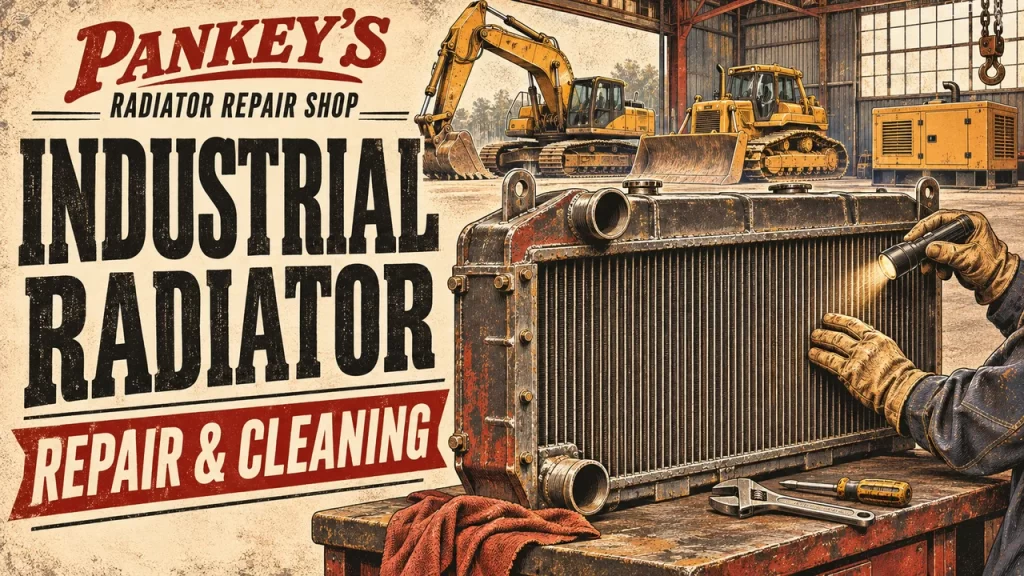
A temperature warning can interrupt a busy shift in seconds. The next decision is harder: does the equipment need radiator cleaning, a repair or a closer look at another part of the cooling system? This guide is for industrial equipment owners, operators and maintenance coordinators who want a clearer service conversation. It covers construction machinery, generators and related cooling components, then explains how Bay Area owners can discuss service with Pankey’s in Hayward. It is not a substitute for the operating and maintenance instructions for your particular machine.
Which industrial equipment uses radiators and related cooling components?
From excavators to generators, cooling problems interrupt very different jobs. Let’s match each machine with the component that needs attention.
An industrial radiator transfers heat from engine coolant to the surrounding air. Its tubes and fins depend on both coolant circulation and airflow. When either side becomes restricted, a machine can have less cooling capacity available for the work it is doing. The radiator is one part of the system, alongside components such as the fan, hoses, coolant and thermostat.
Construction equipment adds a wrinkle: several coolers may share the same compartment. The engine radiator, hydraulic oil cooler and charge air cooler can sit close together without carrying the same fluid. A dirty-looking cooling package is therefore a starting point for inspection, not proof that every component needs the same treatment. Identifying the affected circuit helps keep the service conversation focused.
| Equipment or component | Useful service question |
|---|---|
| Excavators, loaders and dozers | Is debris restricting airflow through the cooling package, or is there a leak or other fault? |
| Industrial forklifts and tractors | Which radiator fits the machine, and what operating conditions surround the overheating? |
| Drilling rigs and generators | Does the temperature rise during a particular load, duty cycle or operating period? |
| Oil coolers and charge air coolers | Which circuit is involved: oil, compressed intake air or engine coolant? |
| Boat and marine heat exchangers | Is the concern heat transfer, flow, leakage or a combination that needs evaluation? |
Pankey’s existing service catalog includes excavator radiators, loader radiators, Caterpillar dozer radiators and other industrial components. This article explains how to think about the problem before arranging service. The machine’s own operating and maintenance instructions remain the reference for operating limits and cleaning procedures.
For equipment-specific symptoms, read the guides to excavator radiator overheating, Caterpillar radiator repair or replacement, industrial forklift radiator problems and loader radiator cleaning.
What causes industrial radiators to overheat?
Machines always seem to run hot when work piles up. Let’s sort out the warning signs before downtime takes over.
Overheating describes a condition, not a diagnosis. A radiator may be involved, but a technician also considers coolant loss, circulation, the fan system, airflow and the operating load. Replacing a radiator without understanding the surrounding system can leave the original problem unresolved. The useful first question is when the temperature rises and what else changes at the same time.
Consider an excavator that works normally early in the shift but runs hotter during sustained digging. That pattern gives the service team different information from a machine that loses coolant while parked. Neither description identifies the cause by itself. Together with inspection and model-specific guidance, operating details help a qualified technician decide what to examine next.
External debris can reduce airflow across cooling surfaces. A leak can reduce the coolant available to carry heat. Damaged fins can affect airflow, while other faults elsewhere in the cooling system may create similar symptoms. These possibilities are reasons to inspect, not a checklist for guessing which part to buy.
Keep checks within the operator’s training and the manufacturer’s instructions. A hot cooling system can remain pressurized. Do not remove its cap while hot or reach into a running fan compartment. Once the machine has been made safe, photographs of accessible components and a clear description are more useful than an improvised repair.
When does an industrial radiator need professional cleaning?
A dirty radiator can hide behind bigger cooling complaints. Here’s how to separate blocked airflow from problems deeper inside equipment.
Professional cleaning becomes worth discussing when debris is difficult to reach, contamination repeatedly returns or a cooling complaint persists after routine maintenance. The goal is to understand the restriction and the condition of the component. A surface that looks cleaner does not establish that the complete cooling package has clear airflow or that the radiator is sound.
Dust, organic debris and oily dirt behave differently. Cooling packages also differ in their spacing, access panels and fin construction. A method that is convenient for a large open core may be unsuitable for a tightly packaged component. Caterpillar’s radiator guidance specifically cautions against high-pressure water, which is one reason a generic pressure-washer instruction does not belong in a service plan.
Ask what kind of cleaning the component needs: exterior cleaning to address airflow, attention to internal contamination, or both. Also ask how its condition will be evaluated. Cleaning cannot repair a split tank, replace missing material or correct a fan problem. It may be part of the solution without being the whole solution.
| What you notice | What to discuss |
|---|---|
| A visible blanket of dust or debris | Access to the whole cooling package and the appropriate cleaning method. |
| Dirt trapped between stacked components | Whether routine access reaches the affected surfaces. |
| Oily contamination that keeps collecting dirt | The source of the contamination as well as removal. |
| Continued temperature warnings after cleaning | Further cooling-system diagnosis rather than repeated cleaning alone. |
For ongoing planning, use the machine’s maintenance schedule and the conditions it actually works in. A dusty demolition site and a relatively clean yard do not create identical exposure. Avoid assigning every machine the same cleaning interval just because both are industrial. Service history and inspection results make the schedule more useful than a universal number.
What is the difference between radiator cleaning and a coolant flush?
Cleaning and flushing sound similar, but they tackle different problems. Knowing the difference makes your next service conversation much easier.
Exterior radiator cleaning concerns the air side: the fins, accessible core surfaces and surrounding area that air must move through. A coolant-system flush concerns the coolant side and the wider circuit. A component may need one type of attention, the other, both or a different repair entirely. Using the terms interchangeably can make an estimate sound more complete than the work it describes.
Imagine the outside of a cooler covered in dirt. Replacing the coolant does not remove that blanket. Now imagine an externally clean radiator with a leak or a suspected internal restriction. Washing the exterior does not establish the condition of the coolant passages. Clear terminology helps the owner and shop discuss the actual complaint.
| Service discussion | Primary focus | What it does not establish |
|---|---|---|
| External cleaning | Airflow across cooling surfaces | That internal passages are clear or the unit is leak-free. |
| Coolant service or flushing | The coolant circuit, according to the manufacturer’s procedure | That external fins and stacked coolers are clean. |
| Component inspection and testing | The specific question being investigated | That unrelated cooling-system faults are absent. |
| Radiator repair | A repairable defect identified in the component | That all overheating has the same cause. |
Chemical selection, coolant compatibility and flushing procedures depend on the equipment and contamination. This is not a place for a one-size-fits-all household cleaner or mixing advice. Tell the shop what fluids or cleaning products have already been used, if known. An incomplete history is still better than treating an unknown mixture as an established specification.
When asking about service, describe the symptom before requesting a particular procedure. “The loader overheats after an hour and the cooling stack collects oily dust” gives more direction than “It needs a flush.” Let the inspection determine whether cleaning, coolant service, repair or another diagnosis is appropriate.
When should you consider radiator repair or replacement?
A leak doesn’t automatically mean a new radiator. The useful question is what condition the rest of your unit shows.
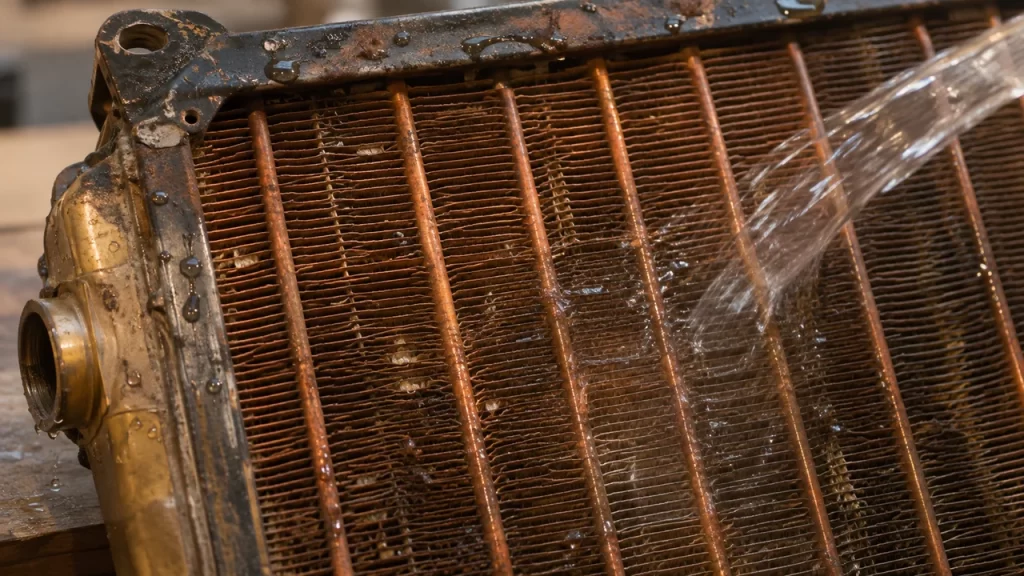
Repairability depends on the construction and condition of the specific component. The location of a defect, the surrounding material, corrosion and the extent of damage all matter. An isolated issue in otherwise serviceable material is a different decision from widespread deterioration. An inspection should explain that difference before a repair or replacement decision is made.
Material names alone do not settle the question. Aluminum, copper-based assemblies and other constructions use different joining and manufacturing methods. A statement that every aluminum radiator is repairable is as unhelpful as a statement that none can be repaired. Ask the shop to explain the options for the unit in front of it.
| Decision factor | Question for the service team |
|---|---|
| Extent of damage | Is the defect localized, or is there deterioration elsewhere? |
| Core and tank condition | Is the surrounding structure suitable for the proposed work? |
| Component construction | What repair or replacement options suit this specific design? |
| Repeated failures | Could mounting, vibration or another system issue be contributing? |
| Equipment requirements | Will the proposed component match fit, connections and cooling needs? |
Replacement also needs identification work. A component that appears similar may differ in mounting points, neck position or other features. Supply the machine model, serial information and component identification where available. A photograph supports that process, but it should not be the only basis for selecting a replacement.
The best estimate is one that identifies the problem, proposed scope and remaining uncertainties. Request a written description of what is included. Price alone is difficult to compare when one option addresses only a leak and another includes different component work. Make the comparison about the actual job rather than an assumed percentage saving.
What affects service cost, timing and preparation?
Nobody enjoys surprises when equipment is already sidelined. A few details upfront can make discussing service options much more straightforward.
The component, its condition and the work needed influence the estimate. Access requirements, identification, parts availability and inspection findings may also affect planning. A shop cannot reliably price an unknown leak from the word “radiator” alone. Sharing the right information makes the first conversation more productive, even when a final quote needs an inspection.
- Equipment make, model and available serial or component numbers.
- Whether the concern involves the engine radiator, oil cooler, charge air cooler or heat exchanger.
- Symptoms, when they occur and whether the machine is losing fluid.
- Clear photographs of the whole component, its connections and accessible problem areas.
- Recent repairs, coolant changes or cleaning attempts.
- Your Bay Area location and the timing you are trying to coordinate.
Before moving equipment or removing a component, discuss what the shop accepts and how the work should be arranged. Do not assume that a radiator shop provides machine transport, field service, lifting or complete engine diagnosis. Those are separate questions, and a clear plan prevents arriving with the wrong item or missing essential information.
For a fleet, label the component with the machine identity and keep the service history attached to the work order. Similar-looking radiators can belong to different units. Recording the original complaint also helps the person reinstalling or operating the machine understand what was investigated. That handoff matters when the person arranging service is not the operator who noticed the problem.
The same approach applies whether the equipment works in Hayward, an East Bay yard or another Bay Area location. Describe the job and location accurately, then confirm arrangements with the shop. Avoid promising a return-to-work date before the component, scope and surrounding mechanical issues have been evaluated.
What do equipment owners ask about industrial radiator service?
Still have a few questions before calling a shop? Let’s cover the practical details that equipment owners usually want clarified.
Can a radiator look clean but still have an airflow problem?
Yes. A visible front surface is only part of the cooling package. Debris may be difficult to see or reach between components, and other airflow problems can have similar symptoms. An inspection should consider access and the complete cooling arrangement rather than judging the system from its appearance alone.
Can radiator cleaning fix a coolant leak?
Cleaning and leak repair address different problems. Removing dirt may make an area easier to inspect, but it does not establish that a crack, seam or connection has been repaired. Describe both the contamination and coolant loss so the service discussion covers the actual condition of the component.
Does overheating always mean the radiator needs replacement?
No. Coolant loss, airflow, fan operation, circulation and other conditions can contribute to overheating. The radiator may need attention, but the symptom alone does not identify the faulty part. Follow the equipment’s warning instructions and arrange an appropriate evaluation before deciding which component should be repaired or replaced.
How often should an industrial radiator be cleaned?
Use the machine’s maintenance instructions and inspection findings. Exposure differs between dusty construction work, material handling and other operations. A fixed interval for every machine can miss those differences. Keep a record of buildup, operating conditions and completed service to support a schedule appropriate to the equipment.
Can aluminum industrial radiators be repaired?
Some damage may be repairable, while the construction or condition of another unit may make replacement more appropriate. Material alone is not enough to decide. The relevant question is whether the specific component has a suitable repair option after its design, damage and surrounding material have been evaluated.
Is a charge air cooler the same as an engine radiator?
No. The engine radiator handles engine coolant, while a charge air cooler removes heat from compressed intake air. They may share a cooling compartment but belong to different circuits. Tell the service team which component is involved, or provide identification details and photographs if you are unsure.
Should I bring a loose radiator or the complete machine?
Confirm arrangements with the shop before transport or removal. Accepted work, component handling and access requirements can differ. Explain what equipment you have and whether the component is still installed. That lets you discuss the appropriate next step without assuming that every shop accepts complete machines or offers transport.
What information helps when requesting service in the Bay Area?
Start with your equipment type, available identification, location and a concise description of the symptoms. Include photographs and any recent cooling-system work. Ask what further information or inspection is needed. A clear description is more useful than requesting a particular repair before the cause has been evaluated.
How can Pankey’s help with industrial radiator repair and cleaning?
If cooling problems are slowing your work, tell Pankey’s what equipment you have and what’s happening. Start with that conversation.
Pankey’s Radiator Repair Shop in Hayward lists repair and cleaning services for industrial radiators and related cooling components. Its service pages cover construction equipment, industrial forklifts, drilling rigs, tractors and generators, along with oil coolers, heat exchangers and heavy commercial truck radiators.
For a specific machine, begin with the relevant page: Caterpillar radiator service, industrial forklift radiators or generator radiators. You can also browse the industrial cooling service catalog when you are identifying the component.
Tell Mario or Paul what is running hot, whether you have noticed leakage and where your equipment operates. Ask which repair or cleaning options can be considered and what information is needed before arranging service. The conversation can focus on your equipment and its condition without assuming that every cooling complaint calls for the same repair.
Call 510-581-6804 Request Service
Pankey’s Radiator Repair Shop · 21805 Foothill Blvd, Hayward, CA 94541 · Serving Bay Area equipment owners. Call to discuss your component, location and service needs.
